
As the day lengthens, the cold strengthens.
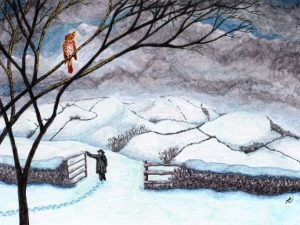 Well, that was certainly true this year. The mild December had five seasonal bells knocked out of it by a vicious cold snap. Family health issues continued, and I found myself wielding a snow shovel to clear the drive so that I could get the car out for a hospital visit. I was almost tempted to build a snowman, but there’s not much fun in doing that alone. To be frank, I was glad to get inside after thirty minutes of hard labour.
Nevertheless, it has to be said that crisp, clear days are beautiful, and it would be churlish and wasteful not to get outside and appreciate them. Arctic-level clothing, sturdy walking boots and a brisk gait soon warm the blood enough to stop and take in the landscapes. A winter’s sunset can be undeniably spectacular or pale and desolate. The latter always reminds me of one of my favourite poems by Thomas Hardy, ‘The Darkling Thrush’.
I leant upon a coppice gate
When Frost was spectre-grey,
And Winter’s dregs made desolate
The weakening eye of day.
The tangled bine-stems scored the sky
Like strings of broken lyres,
And all mankind that haunted nigh
Had sought their household fires.
The land’s sharp features seemed to be
The Century’s corpse outleant,
His crypt the cloudy canopy,
The wind his death-lament.
The ancient pulse of germ and birth
Was shrunken hard and dry,
And every spirit upon earth
Seemed fervourless as I.
At once a voice arose among
The bleak twigs overhead
In a full-hearted evensong
Of joy illimited;
An aged thrush, frail, gaunt, and small,
In blast-beruffled plume,
Had chosen thus to fling his soul
Upon the growing gloom.
So little cause for carolings
Of such ecstatic sound
Was written on terrestrial things
Afar or nigh around,
That I could think there trembled through
His happy good-night air
Some blessed Hope, whereof he knew
And I was unaware.
What I’m working on
January has seen me working on a few pieces of academic work resulting from an enquiry through the York Editors directory page. The York Editors are a lovely bunch of friendly and professional editors and proofreaders, and we meet up when we can to discuss editorial issues and have a jolly good catch-up.
There are strict guidelines to adhere to when proofreading academic work because the writing must be the student’s and not that of an editor. It is a case of correcting only what is wrong in terms of word usage, spelling, punctuation, capitalisation, italics, abbreviations, headings, quotations, metrification, numbering, citations, referencing, tables, illustrations, footnotes and appendices. Any inclination to exceed that remit has to be firmly resisted to ensure that the work remains that of the student.
However, proofreading academic work is enormously enriching. It educates me in fields that are quite alien to my experience. ASCII art and Geographic Information Systems are now much less alien, and I am grateful to increase my knowledge bank.
What I’ve learned
Proofreading academic work requires the gentlest touch possible to ensure it does not stray into the field of editing. Issues related to syntax, clarity of expression, voice and tone, ambiguity and repetition may be identified but not corrected.
References and bibliographies require the greatest concentration when proofreading, and it is essential to follow detailed guidance provided by the academic institution or department. References may follow three systems: the short-title system (mainly used in humanities books and journals), the author-date system (commonly known as the Harvard system) and the number system (also known as the Vancouver system). However, each institution or department may have specific requirements within these systems, which must be followed precisely.
The proofreader must have clear guidelines on how references and bibliographies should be presented before commencing work, and that work must be methodical. A clear head and a conscientious approach are key.
What I’m watching
When the first season of Wolf Hall was released, I watched it immediately as I have a keen interest in the Tudor era. I found it engaging in every respect. Mark Rylance and Damien Lewis were perfect choices for the roles of Thomas Cromwell and King Henry VIII. The costumes were glorious, the filming locations were contemporaneous and the music was beautiful. I remember reading criticisms that the lighting was too dim, but I appreciated that as an authentic depiction of rooms that could only be lit by fires and candles.
 I have waited many years for the sequel, The Mirror and the Light, and I was not disappointed. Rylance and Lewis reprise their roles seamlessly, and it feels like a natural progression. It has been a joy to watch. Of course, the series is sympathetic to the protagonist, Thomas Cromwell, with many other characters portrayed less favourably. It is up to the viewer to conduct their own research if they wish to delve deeper into the characters.
What I’m listening to
It’s catch-up time for The Archers again! December was such a busy month professionally and personally that The Archers had to be put on the back burner. I now have to put some serious time into this before the earlier episodes I haven’t listened to are removed.
I always try to listen to Relaxing Evenings with Zeb Soanes when I cook our evening meal. Much of the music played is familiar to me, but I am frequently presented with a piece that is new to me. I am not a good cook, and I rather resent what I perceive as a chore, so having relaxing classical music accompany my labours is most welcome.
What I’ve been doing
January hit us with a wintry blast that sapped energy and motivation. Our New Year’s Day lunch was postponed because of another family member succumbing to illness. This also resulted in a hospital stay for a few days, followed by two weeks of recuperation at home. Again, the NHS exceeded my expectations by conducting targeted tests, coming to a swift diagnosis and treating the problem successfully.
I was treated to unlimited cups of tea and mince pies as a thank-you for editing the parish magazine. Mince pies are always welcome.
What I’m stitching
Having sidelined the stitcher’s etui I started last year, I am now working on it again and am determined to finish it. It is easy to work on because tent stitch is the only one used, but that can make it somewhat repetitive. I like to work on it when listening to podcasts or audiobooks; carrying out two tasks simultaneously is a bonus (not, of course, ‘an added bonus’ as that would be a tautology).
What I’m looking forward to
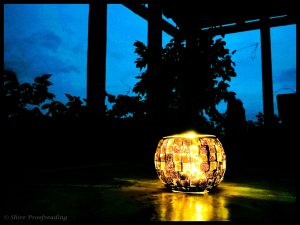 February – yes, that’s right. Candlemas, on 2 February, gives us a 50–50 chance of learning that the worst of winter is over. If Candlemas is overcast, tradition has it that the hibernating animals who leave their winter dens stay out because there is no shadow to scare them. Should the animals see their shadows, they scurry back into hibernation, and winter will have another flight. Even if winter is to make a return, February is a short month, and I can handle that.
Next month brings the March–April issue of Round Up. Even though I will edit that issue in the middle of February, it lifts the spirits to think ahead to spring, and I like to include images of new life on the front cover.