
In Like a Lamb …
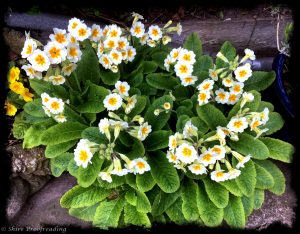
We are heading quickly towards the end of March, and I have taken full advantage of the warmer days we have enjoyed over the last few weeks. The month of March came in like a lamb this year, and the cheerful yellow hues of the daffodils and primulas are a welcome sight. Spring is now upon us, and the gardens are shaking off their winter blanket and bursting towards the new season.
 Longer days will soon be upon us, and gardeners are getting their tools ready to tackle the abundance of growth that will surely follow. Of course, that also includes weeds. I firmly believe that weeds have twice as much growing power as shrubs.
However, I never remove the clumps of wild comfrey that have self-seeded in my garden. Their little white flowers provide some of the best pollen for bees, and each plant is buzzing with bee activity when the flowers are open. Dandelions are a favourite too, and I like to use those in the lawn as an excuse for less frequent mowing.
It remains to be seen if March will go out like a lion.
What I’m working on
This month I have had the pleasure to work on a book aimed at improving the understanding and welfare of reptiles kept in captivity. For far too long reptiles have often been kept in suboptimal conditions in terms of cage size, heating, lighting, substrates, nutrition, planting and water provision. Many reptiles have been kept as entry-level pets by owners who have little understanding of their needs.
This series of books aims to educate owners about the conditions that are present in the reptiles’ wild environments and encourage them to provide caged environments that replicate these conditions as closely as possible. In this way owners can give their charges the best lives possible, increase their welfare and, as a result, enjoy healthier, more active pets.
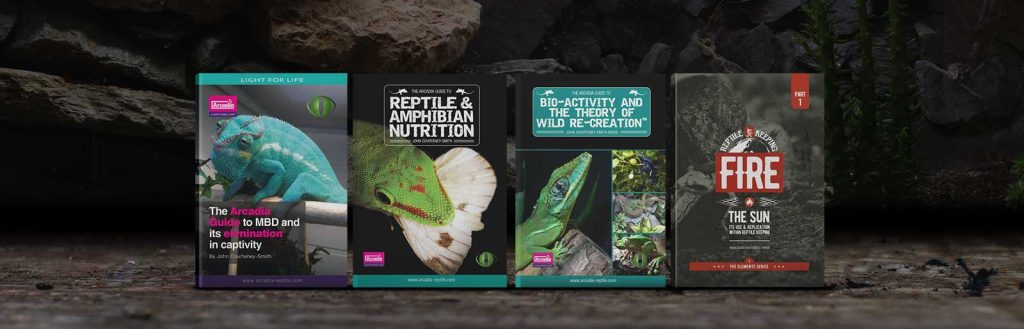
Arcadia Reptiles are specialists in heating, lighting and nutrition. Anyone who keeps reptiles or is considering venturing into this field should consult the series of books they have produced.
What I’ve learned
Many people consider proofreading as a simple check for spelling errors. I was guilty of that misconception before I began my training and worked on my first few pieces. If that were the case, our job would be akin to ‘money for old rope’.
Two of the most challenging aspects of proofreading are style choices and consistency.
A manuscript may contain the same word spelled in several different ways in respect of capitalisation, punctuation and typography. If a style sheet has been provided by the editor, the proofreader may have no choice to make. However, if no style sheet is available, it is the responsibility of the proofreader to make those decisions and create a style sheet. These decisions can often be a compromise between accepted usage in publishing and majority usage in the manuscript.
Consistency can be one of the most difficult aspects to achieve, but it is critical for a well-proofread manuscript. That is where the word list section of the style sheet comes in. Where a word can be treated in several ways, such as hyphenation, the proofreader makes a style choice and ensures this is applied to every instance in the manuscript. Logging every style decision on words in the word list enables the proofreader to check usage throughout the text easily.
What I’m watching
I have always loved birds; this is an interest I learned from my mother when I was very young. She fed the birds in her garden every day of her life, and I was drafted in as a young child to help her with this task. I remember sweeping snow from the ground in winter to provide a clear surface on which to spread the food. I stood on a stool at the kitchen window, and Mum would point out the birds and tell me their names.
Of course, they were the garden birds we see today, such as blackbirds, sparrows, dunnocks, blue tits, great tits, chaffinches and robins. I have continued her daily habit of feeding in my garden, and I take just as much enjoyment in watching the birds as I did when I was standing on that stool.
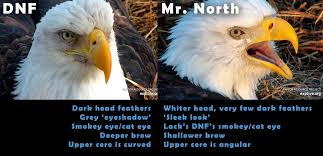 The internet has made it possible to expand my avian interests, and I can now advance to watching larger, non-native birds. A family member who lives in Illinois alerted me to the Decorah North Bald Eagles webcam a few weeks ago. Now I am hooked. This webcam follows a pair of bald eagles nesting in Iowa. The first egg was laid on 11 February, and the second on 14 February. Bald eagle eggs take around 35 days to hatch. Pipping (where the chick uses its egg tooth to break through the shell) has already occurred – hatching is imminent.
What I’m listening to
 BBC Sounds recently released a new series of A Charles Paris Mystery, ‘Situation Tragedy’. Bill Nighy is perfectly cast as the actor/amateur sleuth, but I also have a particular affection for Jon Glover, who plays Charles’ agent, Maurice.
These podcasts are expertly dramatised by Jeremy Front from the stories written by Simon Brett. They are not available for long on the BBC Sounds platform; therefore, subscribing to the podcast is the best way to catch them.
Bill Nighy’s character is cynical and somewhat jaded but must surely resonate with many listeners. The series is mainly comedic, but the mystery element adds a layer of ‘whodunnit’ that keeps the audience guessing. I can recommend them most highly.
What I’ve been doing
After many years of being a koi carp keeper, I decided the time had come to retire from the hobby. It is precisely because I loved my ‘kippers’ so much that I knew I was no longer the best person to care for them. I worried about their health and well-being to the point that it was no longer an enjoyment; it had become a stress.
I was fortunate to find an experienced koi keeper in the neighbouring village who was willing to take them. After visiting his pond and reassuring myself that he was a dedicated keeper, I let them go but not without a few tears.
Now we begin the long job of dismantling the pond and filling it in. Luckily, I have found a couple nearby with 100 bags of soil and rubble to dispose of. It’s going to take plenty of trips in the car, but I will gradually fill that hole and then decide how best to use the space.
What I’m looking forward to
Of course, I am looking forward to seeing the two bald eagle eggs hatch. Then the arduous work begins for the parents, and it will be fascinating to see them rear the eaglets. They will be nestlings for ten to twelve weeks. Once the parents are heartily sick of feeding them eight times a day, they will encourage them to fledge and may even withhold food to encourage them to do so.